
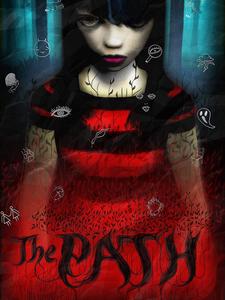
The Path
- First release
- Mar 18, 2009
- Publisher
- Tale of Tales
- Platforms
- PC (Microsoft Windows), Mac
Attributes
Details
Storyline, release dates, time to beat, age ratings, modes, links, keywords
- Storyline
The game begins in an apartment. The player is shown six sisters to choose from and is given no information about them other than a name. When the player selects a girl, the journey begins. The player is given control of the girl, and is instructed: "Go to Grandmother's house and stay on the path." As the player explores, they find various items scattered around. For a girl to pick up or examine an object, the player needs to either click on the interaction button or move her close enough for a superimposed image of the object to appear on the screen, then let go of the controls. The character will interact and an image will appear on the screen, indicating what has been unlocked; every item a girl encounters in the forest shows in some shape or form in Grandmother's house, and some objects open up whole new rooms. Small text will also appear, a thought from the current character. Some items can only be picked up once and do not appear in subsequent runs. However, each character will say something different about an object, so the player has the option to access a "basket" to see what they have collected. It is not required to find the Wolf. In this game, there are no requirements but the ending at Grandmother's house does change dramatically after the wolf encounter. The girl encounters the Wolf, there is a brief cut scene, and the screen goes black. Afterward, the girl is lying on the path in front of Grandmother's house. When the player enters Grandmother's house, the style of gameplay changes. It is now in first person, and the character moves forward along a pre-determined path. If the player got there without interacting with the Wolf, they arrive safely, cozy up next to Grandmother and are sent back to the apartment. The girl the player guided will still be there, and can be played again. If the player did go to the Wolf, then everything in the house is darker, and if the player remains still for too long, darkness clouds the screen, and something growls. Depending on the girl, doors are scratched, or furniture tipped over and broken, or strange black threads are draped across everything. Instead of ending with Grandmother, the music crescendos as the player enters a final surreal room before falling down, and things black out again. Images flash on the screen, featuring the girl being attacked by her Wolf, before the player is relocated back in the apartment. The girl played is not there, and will remain absent. When all of the girls have encountered their wolves, a girl in a white dress, who could be previously encountered by the sisters, becomes playable and visits Grandmother's house. The girl will then travel through the house, now a combination of all of the end rooms of the previous girls ending with the no-wolf room. Upon reaching the grandmother, the girl appears in the apartment covered in blood, but alive. The sisters all return through the door and the game starts over.Read more
The game begins in an apartment. The player is shown six sisters to choose from and is given no information about them other than a name. When the player selects a girl, the journey begins. The player is given control of the girl, and is instructed: "Go to Grandmother's house and stay on the path." As the player explores, they find various items scattered around. For a girl to pick up or examine an object, the player needs to either click on the interaction button or move her close enough for a superimposed image of the object to appear on the screen, then let go of the controls. The character will interact and an image will appear on the screen, indicating what has been unlocked; every item a girl encounters in the forest shows in some shape or form in Grandmother's house, and some objects open up whole new rooms. Small text will also appear, a thought from the current character. Some items can only be picked up once and do not appear in subsequent runs. However, each character will say something different about an object, so the player has the option to access a "basket" to see what they have collected. It is not required to find the Wolf. In this game, there are no requirements but the ending at Grandmother's house does change dramatically after the wolf encounter. The girl encounters the Wolf, there is a brief cut scene, and the screen goes black. Afterward, the girl is lying on the path in front of Grandmother's house. When the player enters Grandmother's house, the style of gameplay changes. It is now in first person, and the character moves forward along a pre-determined path. If the player got there without interacting with the Wolf, they arrive safely, cozy up next to Grandmother and are sent back to the apartment. The girl the player guided will still be there, and can be played again. If the player did go to the Wolf, then everything in the house is darker, and if the player remains still for too long, darkness clouds the screen, and something growls. Depending on the girl, doors are scratched, or furniture tipped over and broken, or strange black threads are draped across everything. Instead of ending with Grandmother, the music crescendos as the player enters a final surreal room before falling down, and things black out again. Images flash on the screen, featuring the girl being attacked by her Wolf, before the player is relocated back in the apartment. The girl played is not there, and will remain absent. When all of the girls have encountered their wolves, a girl in a white dress, who could be previously encountered by the sisters, becomes playable and visits Grandmother's house. The girl will then travel through the house, now a combination of all of the end rooms of the previous girls ending with the no-wolf room. Upon reaching the grandmother, the girl appears in the apartment covered in blood, but alive. The sisters all return through the door and the game starts over.
- Release dates
- PC (Microsoft Windows)
- Mar 18, 2009
- Mac
- Mar 18, 2009
- Age ratings
- ESRB M
- Game modes
- Single player
- Perspective
- Third person
- External links
- itch.io (opens in a new tab)Official site (opens in a new tab)Twitch (opens in a new tab)Steam (opens in a new tab)
- Keywords
- exploration, psychological horror, medieval, surrealism, female protagonist
… All 14
, psychological horror, medieval, surrealism, female protagonist, forest, multiple protagonists, multiple endings, explorable world, surreal, single-player only, young protagonist, indie royale, goths
At a Glance
- Critic Score
- 80

Overview
Steam review summary
Steam users rate this Very Positive, 885 reviews in all languages, recorded 16 October 2026
Valve's summary of Steam user reviews. Valve counts only reviews from purchases on Steam, not key activations, and leaves out review periods it has marked as off-topic. It isn't part of the CritScore score.
Review summary: SteamSteam data provided via the Steam Web API (opens in a new tab)Not affiliated with Valve →
How it plays
From Steam
- Walking Simulator
- Indie
- Horror
- Female Protagonist
- Exploration
- Adventure
- Surreal
- Experimental
Tags: SteamSteam data provided via the Steam Web API (opens in a new tab)Not affiliated with Valve →
Languages
- Englishinterface
- Danskinterface
Language data: IGDB · recorded 7 Oct 2026
Features
Steam features
- Steam Family Sharing
Feature data: SteamSteam data provided via the Steam Web API (opens in a new tab)Not affiliated with Valve →
Steam Deck
Valve rates this game Playable · recorded 16 Oct 2026
Check on Steam →Steam Deck compatibility data: Valve, via the Steam Web APISteam data provided via the Steam Web API (opens in a new tab)Not affiliated with Valve →
Media
Screenshots
Videos
Community
Player reviews
Be the first to review
Behind the game
Credits
Composer
- Jarboe
Credits from Wikidata (opens in a new tab) (CC0) · checked
Correct or remove a credit (email privacy@critscore.app)Related

About storefront and compatibility information
Compatibility, feature and availability information shown on this page is recorded from the storefronts and services named against each fact, on the dates shown. Steam and the Steam logo are trademarks of Valve Corporation; Steam data is provided via the Steam Web API. Other product and service names are trademarks of their respective owners. CritScore is not affiliated with, endorsed by, sponsored by or certified by Valve Corporation or any other storefront or platform holder, and does not itself test or certify any game.
